Agentic AI Workflow Automation: The UI Is Dead – Long Live the UI

Key takeaways
- Operator UIs are dying: APIs and AI agents are replacing traditional dashboards for repeatable workflows. But novel decisions still need a human at the wheel, and governance visibility must remain a priority.
- Monitoring and review UIs are more important than ever: As automation handles execution, dashboards that surface outcomes, catch failures, and provide compliance audit trails are becoming the core product.
- The future UI is something you trust, not something you click: The UI is bifurcating into agent-operated backends and human-facing oversight layers. Design beautifully for seeing; automate everything built for doing.
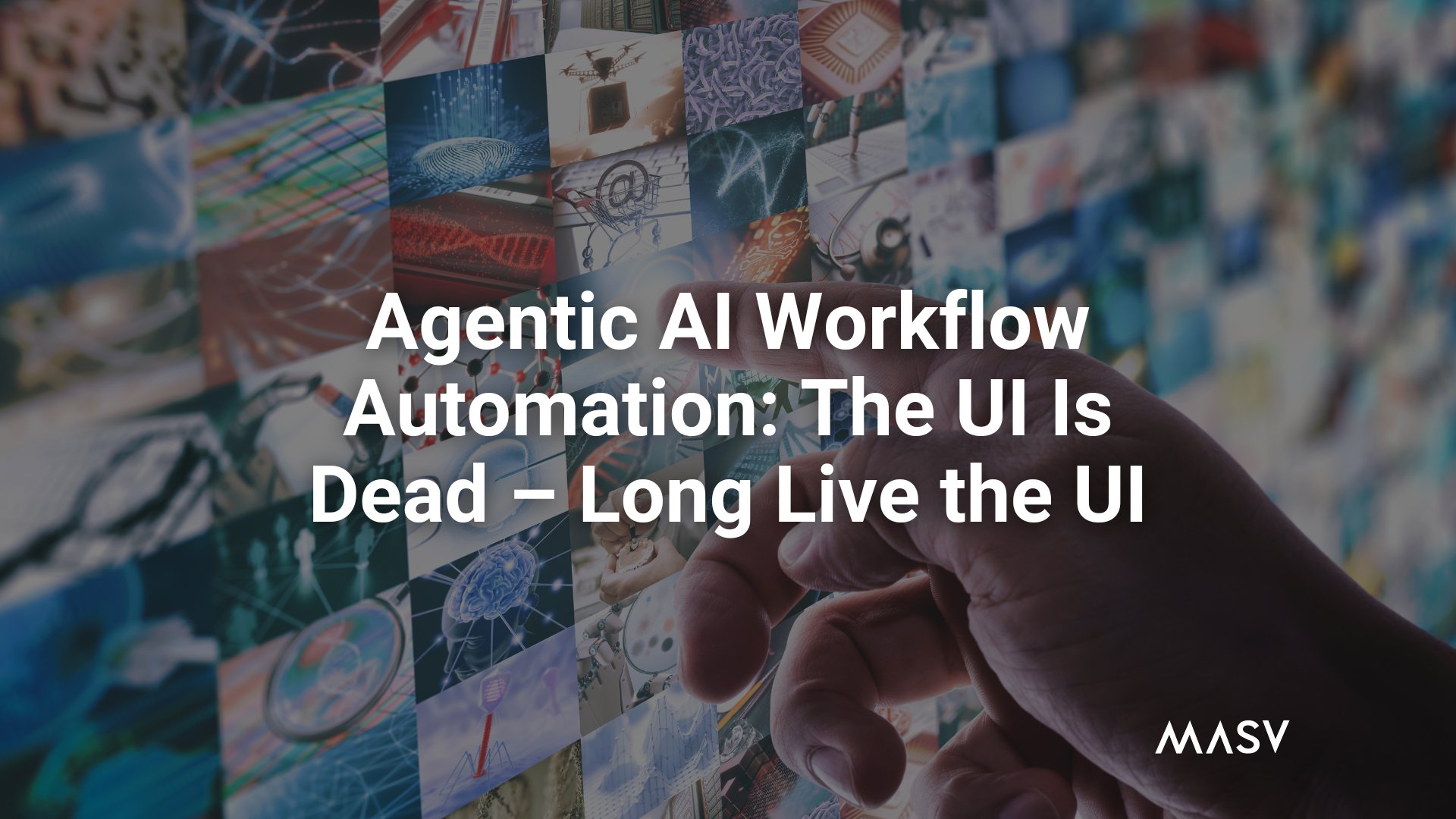
One user interface is dying. It's the one where humans click buttons to build outcomes – the dashboards for configuring, routing, tagging, transcoding, and triggering complex processes.
At the same time, however, another interface is more alive than it has ever been – the one where humans consume outcomes that agentic AI workflow automation and systems built for them.
How agentic workflows have changed the nature of the UI is one of the most important shifts happening in software right now. Problem is, most companies are optimizing the wrong half of it.
What’s dying: Interaction and Operator UI
For decades, enterprise software and related business processes have been built around the user interface: log in, click through to a workflow, configure a pipeline, and hit submit.
But that traditional interface is being quickly dismantled by APIs and tools for enabling AI agents, where agents communicate to perform specific tasks. Michael Grinich of WorkOS captured this underlying shift when he said software is moving from interfaces you operate, to AI agentic workflows driven by human and AI agents that simply produce outcomes.
The evidence is everywhere:
- Salesforce's Headless 360 launch in April 2026 came with a blunt message: no browser required, and the API is the UI. By June, Salesforce was showcasing customers like Indeed running Agentforce agents entirely through code, with no browser UI at all.
- AWS Elemental MediaConvert now runs serverless watch-folder workflows with zero UI interaction required
- IBC 2026's Accelerator Innovation Programme is built around agentic orchestration, automated production, highlight generation, localization, and personalization, chained together without a human clicking through each step.
Recent research backs up this trend line: Gartner says the share of enterprise apps embedding AI agents is projected to jump from under 5% in 2025 to 40% by the end of 2026.
To be fair, this isn't a universal death sentence – Gartner also warns that 40% of enterprises will roll back agent deployments by 2027 due to governance gaps.
My take: the user interface isn't dying everywhere. It's dying specifically for repeatable workflows. Novel decisions and complex tasks still need human oversight – but repeatable is primarily what operator dashboards were built for, which is why so many of them are becoming obsolete.
Lastly, as Gartner’s data implies, governance cannot be an afterthought: those trying to run 100% headless without visibility are destined to fail. Governance controls must always be at the forefront.

What’s thriving: Consumption and Monitoring UI
Most no-code, no-UI hot takes fail to recognize that someone still has to watch, review, approve, and judge what the automation produced. Rather than shrinking, that surface – the display layer – is becoming the entire product.
As The Gradient put it back in March of this year: the interface stopped being where decisions get made, and became the place where they get reviewed, validated, or overridden.
Adobe's Frame.io leaned into exactly that with its unified review and approval rollout in April 2026, expanding the review experience while upload and configuration becomes more automated.
Market data tells the same story. The sports analytics market is estimated to reach nearly $10 billion in value by 2030, growing at a 27% CAGR, almost entirely on the back of dashboards. Case in point: When New York’s YES Network replaced its SDI-based infrastructure with an SMPTE ST 2110 IP environment in June 2026, the project centered on visibility and understanding, with monitoring interfaces prioritized above operator controls.
But it’s also important to understand that more dashboards do not automatically mean better decisions. Cognitive overload is real. AI agents – whether a single agent or multiple agents – tend to fail silently, which means the consumption UI is one of the only things that can alert human operators when things go off the rails.
We should also emphasize that in enterprise environments with high security demands, a consumption and review layer is the mandatory audit trail that proves compliance. Human-in-the-loop approval queues ensure that sensitive data transfers or automated workflows have a verifiable paper trail.
The split: How the UI is Evolving in the Age of Multiple AI Systems
Despite the title of this article, this isn’t so much a case of the UI dying as it is a UI bifurcation: Interaction UI is going extinct, while consumption UI is thriving. Microservices and multi agent systems own the orchestration behind the scenes, and what's left on screen is signal.
“Advances in AI are moving systems from reactive tools to goal-driven agents,” explained the IEEE Computer Society in April. “The interface is no longer the product. The agent is. The UI becomes a fallback layer used for oversight, correction, or edge cases.”
Matt Mayberry's "three eras" technology framing maps the same arc, just a bit differently:
- Era 1 was about the user experience, built around clicking
- Era 2 was about the developer experience, built around APIs
- Era 3 is about the agent experience, where AI is the primary user of the system and the only human-facing UI left is oversight and outcomes
The infrastructure is already reorganizing around this: The headless content management system (CMS) market is projected to grow from $4.38 billion to $20.93 billion by 2033 (a 21.6% CAGR), for example, precisely because that architecture is built for this split. And Pendo product data says that across an average piece of software, just 6.4% of features drive 80% of all activity.
That’s a staggering number, precisely because it means that most of what we've built operator UI for was already dead weight.
If 80% of your product's screens exist purely to configure workflows an agent could run on its own, what's actually left?
My answer: the 20% that surfaces insight to a human being.
How MASV’s Product Roadmap Fits
This article is also the story of MASV’s product roadmap.
We’ve moved from an exclusively upload portal model (click, configure, route, and notify) toward watch folders, APIs, and headless agent-driven automation, where the interface that matters most is the visibility layer providing real-time situational awareness.
Our enterprise positioning already reflects this: no-code integrations and one-to-many automations to storage, MAMs, or other destinations delivered via Watch folders, API, or the headless MASV Engine.
That said, MASV’s manual upload UI isn’t becoming somewhat less important because we don’t like it – rather, it’s because agents and watch folders can do that job at 3 a.m. without anyone touching a mouse.
The Takeaway: Goodbye Setup Wizards, Hello Analytics Dashboards and Specialized Agents
Salesforce, the company that arguably invented the enterprise SaaS dashboard, just told more than 150,000 customers they may never need to log in to browser-based software again.
So what's left? The thing you look at, not the thing you click:
- Dead: setup wizards, configuration panels, workflow builders, and admin consoles
- Alive: approval queues, analytics dashboards, review interfaces, monitoring consoles, and audit trails
Here's a test to put in front of every product team: did the human need to see this, or did the human need to do this?
If it’s about seeing, design it beautifully. If it’s about doing (especially around repetitive tasks), automate it.
The UI isn't dead. It just stopped being something you operate, and started being something you trust – backed by the audit trails and oversight that compliance demands.
To learn more about how MASV is evolving its UI and workflows in an increasingly automated world, contact us to speak with a workflow expert or get started with MASV today.
Related articles